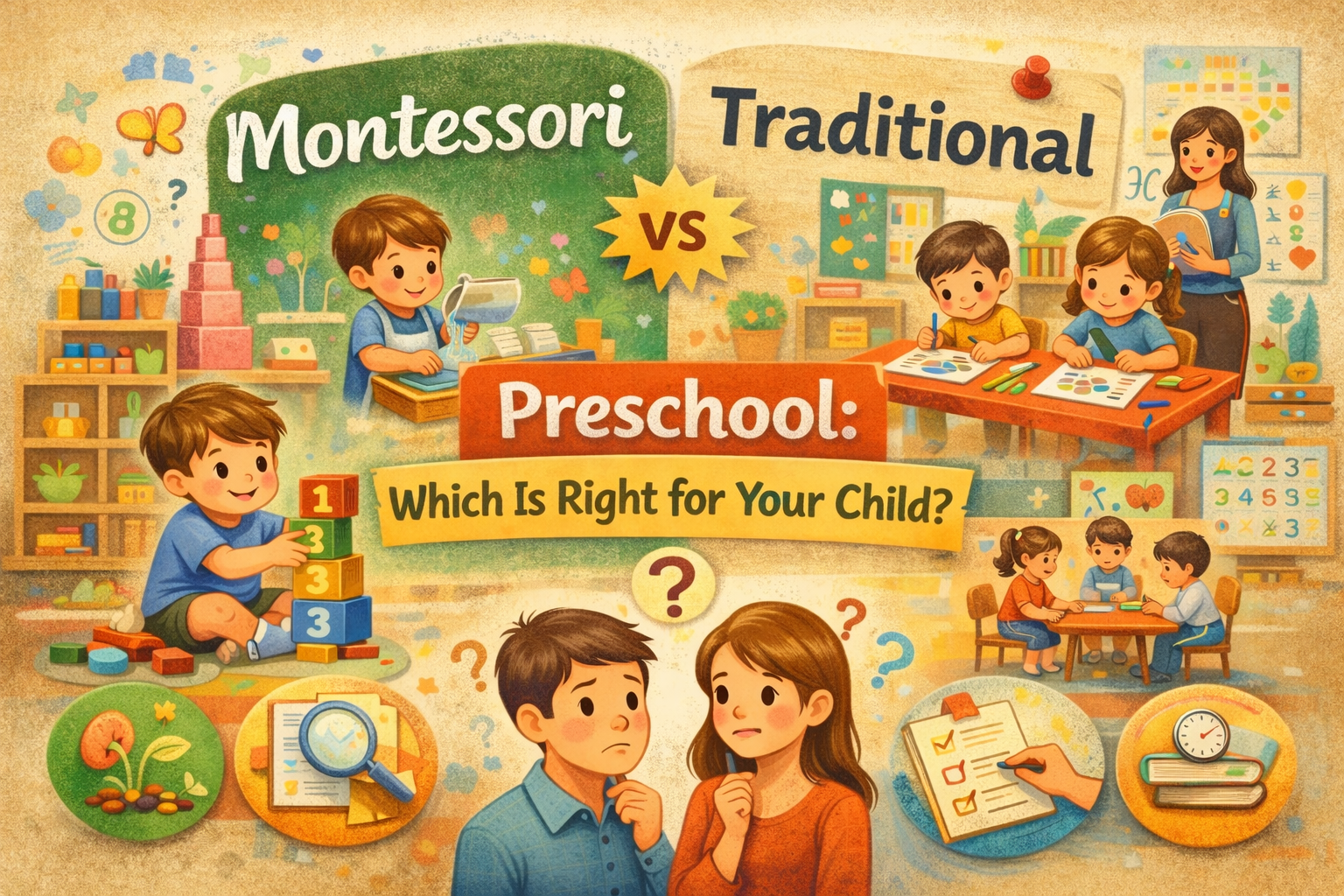

Choosing the right preschool is one of the most important early decisions parents make for their child. The preschool years shape how children approach learning, interact with others, and develop confidence in their abilities. Two of the most common options parents consider are Montessori preschools and traditional preschools. While both aim to educate young children, their philosophies, teaching methods, and classroom environments differ significantly.
Understanding these differences is essential before deciding which approach best suits your child’s personality, learning style, and developmental needs. This guide offers a detailed comparison of Montessori and traditional preschool education to help parents make an informed and confident choice.
Understanding Montessori Preschool Education
Montessori preschool education is based on a child-centered philosophy that emphasizes independence, self-directed learning, and hands-on experiences. Rather than following a rigid curriculum, Montessori classrooms are designed to adapt to each child’s developmental pace and interests.
Children are encouraged to explore activities independently within a carefully prepared environment. Teachers act as guides, observing children and introducing lessons when the child is ready.
Key characteristics of Montessori preschools include:
- Individualized learning paths
- Hands-on learning materials
- Mixed-age classrooms
- Emphasis on practical life skills
- Calm, structured, and respectful environments
The Montessori approach focuses on nurturing the whole child—academically, socially, emotionally, and physically.
Understanding Traditional Preschool Education
Traditional preschools follow a more structured, teacher-led model. The teacher plans lessons and directs activities for the entire class, often following a fixed daily schedule and curriculum.
Children typically learn through group instruction, worksheets, songs, storytelling, and play-based activities. Progress is often measured using assessments, worksheets, and skill checklists.
Key characteristics of traditional preschools include:
- Teacher-directed instruction
- Same-age classrooms
- Standardized curriculum
- Structured schedules and routines
- Group-based learning activities
Traditional preschools aim to prepare children for the expectations of conventional schooling systems.
Key Differences Between Montessori and Traditional Preschool
Understanding how these two approaches differ can help parents evaluate which environment aligns best with their child’s needs.
Learning Style: Child-Led vs Teacher-Led
Montessori Preschool
In Montessori classrooms, learning is child-led. Children choose activities based on their interests and readiness. This autonomy encourages curiosity, motivation, and deeper engagement with learning.
Children are free to work independently or collaboratively, often for extended periods without interruption.
Traditional Preschool
Traditional preschools follow a teacher-led approach. The teacher determines what children learn and when. Activities are often scheduled and time-limited, with the entire class moving together from one task to another.
This structure can be beneficial for children who thrive on routine and direct instruction.
Curriculum and Pace of Learning
Montessori Preschool
Montessori education allows children to progress at their own pace. There is no pressure to meet specific benchmarks by a certain age. Children advance when they demonstrate readiness and mastery.
This approach reduces stress and encourages genuine understanding rather than memorization.
Traditional Preschool
Traditional preschools typically follow a standardized curriculum with specific learning goals for each age group. Children are expected to meet milestones within set timeframes.
While this structure ensures consistency, it may not accommodate individual learning differences as effectively.
Classroom Environment and Setup
Montessori Classroom
Montessori classrooms are carefully prepared environments with child-sized furniture and neatly organized learning materials. Materials are displayed on open shelves, allowing children to choose activities independently.
The atmosphere is calm, orderly, and focused. Children move freely within the classroom, selecting work that interests them.
Traditional Classroom
Traditional classrooms often feature desks or tables arranged for group instruction. Materials are typically controlled by the teacher and distributed during lessons.
The environment is structured around the teacher’s lesson plan, with designated times for learning, play, and rest.
Role of the Teacher
Montessori Teacher
Montessori teachers act as guides or facilitators rather than lecturers. Their primary responsibilities include:
- Observing children closely
- Introducing materials at the appropriate time
- Encouraging independence
- Supporting problem-solving without direct answers
This approach empowers children to take ownership of their learning.
Traditional Preschool Teacher
In traditional preschools, teachers play a more directive role. They lead lessons, manage classroom activities, and provide instructions to the entire group.
Teachers often correct mistakes directly and guide children toward the “right” answers.
Assessment and Progress Tracking
Montessori Assessment
Montessori education emphasizes observation-based assessment. Teachers monitor each child’s progress through daily interactions and record developmental milestones.
There are typically no grades, tests, or formal assessments during early childhood. Progress is measured by skill mastery and developmental growth.
Traditional Assessment
Traditional preschools may use worksheets, quizzes, or performance checklists to assess learning. Progress is often evaluated based on group benchmarks.
This approach provides measurable outcomes but may place pressure on some children.
Social and Emotional Development
Montessori Preschool
Montessori classrooms often include mixed-age groups, allowing younger children to learn from older peers and older children to develop leadership skills.
This structure promotes cooperation, empathy, patience, and respect. Competition is minimized, and collaboration is encouraged.
Traditional Preschool
Traditional preschools group children by age, which can help them bond with peers at similar developmental stages.
Social development often occurs through group activities, playtime, and teacher-led interactions.
Independence and Life Skills
Montessori Approach
Montessori education places strong emphasis on practical life skills. Children learn tasks such as cleaning, organizing, serving snacks, and caring for their environment.
These activities build responsibility, coordination, confidence, and self-reliance from an early age.
Traditional Approach
Traditional preschools may include some life skills but generally focus more on academic readiness and social interaction.
Children may rely more on teachers for guidance and task completion.
Preparing Children for Primary School
Montessori Preparation
Montessori education prepares children for primary school by developing strong foundational skills, self-discipline, concentration, and a love for learning.
Children transition confidently because they are accustomed to working independently and managing responsibilities.
Traditional Preparation
Traditional preschools prepare children for structured classroom settings by introducing routines, group instruction, and teacher-directed learning.
This familiarity can make transitions smoother for children entering conventional school systems.
Which Preschool Is Right for Your Child?
There is no universal answer to this question. The right choice depends on your child’s personality, learning style, and developmental needs.
Montessori May Be Ideal If Your Child:
- Enjoys independent exploration
- Learns best through hands-on activities
- Thrives in calm, structured environments
- Needs flexibility in learning pace
- Shows curiosity and self-motivation
Traditional Preschool May Be Ideal If Your Child:
- Responds well to structured routines
- Enjoys group activities and teacher direction
- Benefits from clear instructions
- Prefers a predictable daily schedule
- Thrives in energetic, social settings
What Parents Should Consider Before Deciding
Before choosing a preschool, parents should:
- Visit classrooms and observe daily routines
- Speak with teachers and administrators
- Understand the school’s educational philosophy
- Assess how the environment aligns with their child’s needs
- Consider long-term educational goals
No matter which approach you choose, a nurturing, safe, and supportive environment is essential.
Final Thoughts
Both Montessori and traditional preschools offer valuable benefits, and each approach can support healthy early childhood development when implemented effectively. Montessori education emphasizes independence, individualized learning, and intrinsic motivation, while traditional preschools offer structure, routine, and teacher-led instruction.
The best preschool is one that aligns with your child’s natural learning style and supports their emotional, social, and academic growth. By understanding the key differences between Montessori and traditional preschool education, parents can make a confident decision that lays a strong foundation for their child’s future success.
Ultimately, the goal is not just school readiness, but fostering confident, curious, and capable learners who enjoy the process of learning itself.