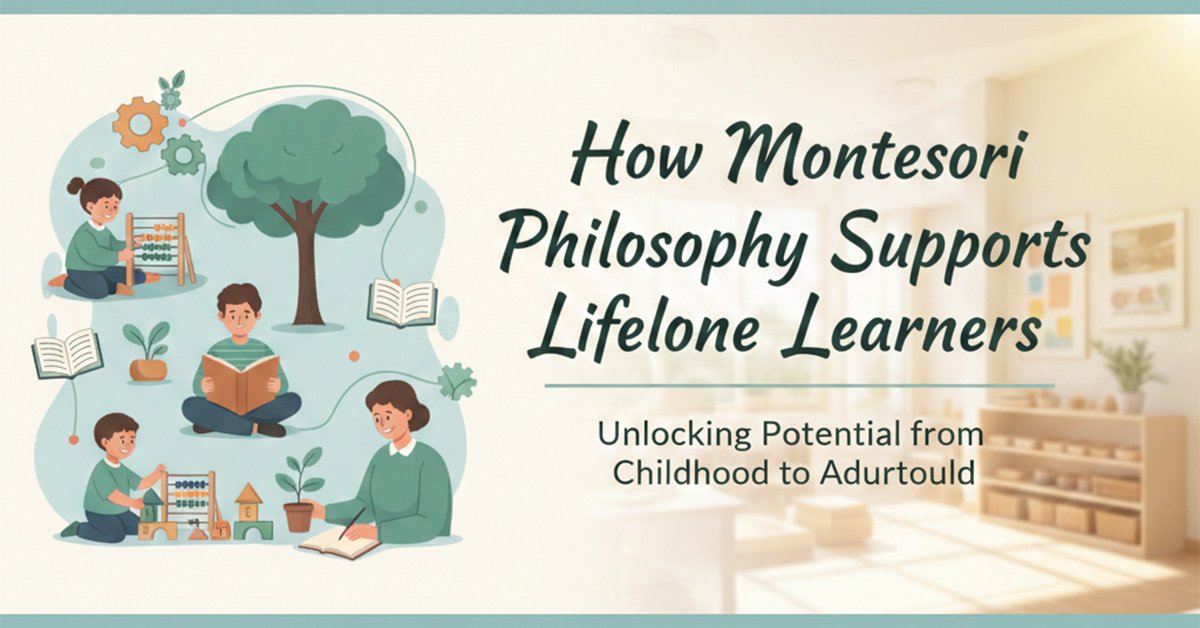

In a rapidly evolving world where adaptability, creativity, and critical thinking are more valuable than rote memorization, education systems must prepare children not just for exams, but for life. One educational approach that has consistently demonstrated its ability to nurture lifelong learners is the Montessori philosophy. Rooted in respect for the child and designed to cultivate independence, curiosity, and intrinsic motivation, Montessori education goes far beyond traditional classroom learning.
This article explores how the Montessori philosophy supports lifelong learning by developing essential skills, mindsets, and habits that stay with individuals well into adulthood.
Understanding Lifelong Learning
Lifelong learning refers to the continuous pursuit of knowledge, skills, and personal development throughout one’s life. It is driven not by external pressure, but by internal motivation and curiosity. Lifelong learners are adaptable, self-directed, resilient, and eager to grow—qualities that are increasingly essential in today’s dynamic social and professional environments.
Montessori education is uniquely positioned to foster these qualities because it emphasizes how children learn, rather than what they memorize.
Core Principles of Montessori Philosophy
To understand how Montessori supports lifelong learning, it is important to first understand its foundational principles:
-
Child-centered learning
-
Self-directed activity
-
Hands-on exploration
-
Prepared environments
-
Respect for individual pace and interests
These principles work together to create learners who are confident, curious, and capable of independent thought.
Encouraging Intrinsic Motivation
One of the strongest ways Montessori supports lifelong learning is by nurturing intrinsic motivation.
Learning for Understanding, Not Rewards
In traditional education systems, children often learn to associate success with grades, praise, or competition. Montessori classrooms, by contrast, remove external rewards and punishments. Children are encouraged to engage in activities because they find them meaningful and interesting.
This shift helps children:
-
Develop a love of learning
-
Take ownership of their education
-
Learn for understanding rather than approval
When learners are internally motivated, they are more likely to continue learning throughout their lives.
Developing Independence and Self-Direction
Lifelong learners must be able to take responsibility for their own growth. Montessori education actively cultivates this ability from an early age.
Freedom Within Structure
In a Montessori classroom, children are given freedom to choose their work within a structured environment. This autonomy teaches them to:
-
Make decisions
-
Manage time
-
Set personal goals
-
Evaluate their own progress
By consistently practicing self-direction, children develop confidence in their ability to learn independently—an essential skill for lifelong learning.
Building Strong Critical Thinking Skills
Montessori education emphasizes understanding concepts deeply rather than memorizing facts.
Learning Through Discovery
Instead of being told answers, children are encouraged to explore, experiment, and problem-solve. Materials are designed to be self-correcting, allowing learners to identify and fix mistakes independently.
This approach helps learners:
-
Analyze information critically
-
Think logically
-
Approach problems creatively
-
Learn from mistakes without fear
These critical thinking skills are foundational for lifelong learners who must continuously adapt to new challenges.
Respecting Individual Learning Pace
Every child learns differently, and Montessori philosophy fully embraces this reality.
Personalized Learning Journeys
Montessori classrooms are not bound by rigid timelines or standardized benchmarks. Children progress at their own pace, moving on only when they have mastered a concept.
This individualized approach:
-
Reduces anxiety and comparison
-
Builds confidence
-
Encourages mastery rather than surface learning
-
Supports long-term retention
When learners feel respected and capable, they are more likely to remain engaged with learning throughout life.
Cultivating Curiosity and a Love for Exploration
Curiosity is the engine of lifelong learning, and Montessori environments are intentionally designed to spark it.
A Rich and Engaging Environment
Montessori classrooms are filled with carefully selected materials that invite exploration. Lessons often begin with open-ended questions rather than fixed answers, encouraging children to investigate topics deeply.
This environment:
-
Encourages questioning and exploration
-
Promotes intellectual curiosity
-
Helps learners connect ideas across subjects
-
Makes learning an enjoyable experience
Curious learners naturally seek knowledge long after formal education ends.
Fostering Concentration and Focus
The ability to concentrate deeply is increasingly rare, yet essential for meaningful learning.
Uninterrupted Work Cycles
Montessori classrooms typically allow long, uninterrupted work periods. Children choose activities that match their interests and work on them for extended periods without constant interruptions.
This practice helps learners:
-
Develop sustained attention
-
Enter deep states of focus
-
Experience satisfaction from completing meaningful work
-
Build discipline and perseverance
These habits support lifelong learning in both academic and professional settings.
Emphasizing Real-World Relevance
Montessori learning is deeply connected to real life.
Practical Life Skills
From an early age, children engage in practical life activities such as cooking, cleaning, organizing, and problem-solving. These activities teach responsibility, independence, and real-world competence.
By connecting learning to everyday life, Montessori helps learners:
-
See the relevance of knowledge
-
Apply skills in real-world contexts
-
Build confidence in their abilities
-
Develop adaptability
This practical orientation ensures that learning continues beyond the classroom.
Encouraging Social and Emotional Growth
Lifelong learning is not purely intellectual—it also depends on emotional intelligence and social skills.
Mixed-Age Classrooms
Montessori classrooms often group children of different ages together. This structure allows younger students to learn from older peers and older students to reinforce learning by mentoring others.
This environment:
-
Builds empathy and cooperation
-
Encourages leadership and collaboration
-
Teaches respect for diversity
-
Strengthens communication skills
Strong social and emotional skills support continuous learning in personal and professional relationships.
Developing a Growth Mindset
Montessori philosophy naturally supports a growth mindset—the belief that abilities can be developed through effort and learning.
Learning From Mistakes
Mistakes are treated as natural and valuable parts of the learning process. Children are not penalized for errors but encouraged to reflect and try again.
This approach:
-
Reduces fear of failure
-
Encourages resilience
-
Builds confidence
-
Promotes continuous improvement
A growth mindset is essential for lifelong learners who must navigate change and uncertainty.
Supporting Lifelong Learning Beyond Childhood
The benefits of Montessori education extend well beyond early childhood.
Research and observations show that Montessori-educated individuals often demonstrate:
-
Strong problem-solving abilities
-
High levels of self-motivation
-
Adaptability in new environments
-
A genuine enjoyment of learning
These qualities align directly with the demands of lifelong learning in adulthood.
Montessori Philosophy in a Changing World
In today’s knowledge-driven economy, the ability to learn, unlearn, and relearn is more important than memorizing information. Montessori philosophy prepares learners for this reality by focusing on skills and mindsets rather than short-term outcomes.
As careers evolve and industries change, Montessori learners are equipped to:
-
Learn new skills independently
-
Adapt to new technologies
-
Think critically and creatively
-
Continue growing throughout life
Conclusion
Montessori philosophy supports lifelong learners by nurturing intrinsic motivation, independence, curiosity, critical thinking, and emotional intelligence. Rather than preparing children for tests alone, it prepares them for life empowering them to become confident, adaptable, and self-directed learners.
In a world where learning never truly ends, Montessori education offers a powerful foundation for personal and professional growth that lasts a lifetime.